The EU attempt to cap Russian gas price means “everyone will freeze” this winter, said Aleksandar Vucic
Moscow might decide to shut off gas supplies completely, if the European Union moves ahead with plans to impose a price cap, Serbian President Aleksandar Vucic warned on Friday.
“If the EU makes such a decision, then Russia could decide to turn off the gas to Europe entirely, and then there will be none of it and everyone will freeze,” Vucic said, adding that the price of electricity would in that case also skyrocket from today’s €400 per megawatt-hour.
The Serbian leader’s comments came in a TV interview after his meeting with Hungarian Prime Minister Viktor Orban. Among the topics they discussed, Vucic said, was the upcoming autumn and winter, which Orban thinks will be “decisive survival in economic terms.”
At their joint press conference in Belgrade, Orban took aim at the EU embargo against Russia, saying that it amounted to “energy dwarfs imposing sanctions against the energy giant.”
Elaborating on the Hungarian PM’s statement, Vucic told TV Pink that the energy crisis will mean hardship for households, but “the main problem will be whose companies and economies will survive” the winter.
Germany can afford to “throw money” at the problem, Vucic said, along with France and maybe Spain – but not the smaller EU members, or Serbia.
Earlier this week, French PM Elisabeth Borne warned that the price of electricity on the spot market could rise tenfold over last year, while the price of gas for 2023 has already increased fivefold since 2021.
Brussels has moved to ban all imports of Russian oil – though some members, such as Hungary, received exemptions – and cut the amount of natural gas, citing the need to support the government of Ukraine in the ongoing conflict and “diversify” its energy sources, at the urging of Washington. However, the US has been unable to step in with deliveries of its liquefied natural gas – at a much higher price, even – to make up the difference.
“There is simply no appropriate alternative to the supply of Russian pipeline gas for Europe. No country is capable of providing resources comparable to the resources and fields of Siberia and the Yamal Peninsula. No one can increase supply using pipeline systems on the terms offered by Gazprom,” the company’s deputy chairman Oleg Aksyutin said on Thursday.
Kiev will allow the transit of Russian ammonia through its territory only if Moscow turns over POWs, the Ukrainian president has said
Ukrainian President Vladimir Zelensky will allow Russia to resume sending ammonia exports through his country, thus easing a global fertilizer shortage, only if Moscow releases Ukrainian prisoners of war, he told Reuters on Friday.
“I am against supplying ammonia from the Russian Federation through our territory. I would only do it in exchange for our prisoners,” Zelensky told the outlet. “This is what I offered the UN.”
The Kremlin quickly dismissed the offer. “Are people and ammonia the same thing?” spokesman Dmitry Peskov responded, as reported by the news agency TASS.
While Zelensky has claimed Ukraine took hundreds of Russian troops as prisoners during its recent counter-offensive in Kharkov, he has acknowledged Russia holds more Ukrainian POWs.
The UN had suggested Russian fertilizer producer Uralchem pump ammonia gas by pipeline to the Ukrainian border, where it could be purchased by Trammo, a US-based commodities trader.
The pipeline can pump as many as 2.5 million tons of ammonia per year from the Volga region to the port of Yuzhny on the Black Sea. However, the port has been closed since the start of Russia’s military offensive in February.
Ammonia is a vital ingredient in nitrate fertilizer, and a shortage in supply threatens to compound the global food crisis, itself already exacerbated by the conflict as much of the world’s wheat comes from Ukraine and Russia.
As many as 70% of European ammonia plants have reduced or halted production in recent months due to record-high energy prices, according to the Russian fertilizer industry.
Russia, Ukraine and Turkey signed a UN-brokered deal in July to resume grain exports from Ukraine’s Black Sea ports to alleviate the shortage. However, Russia’s representative to the UN, Vassily Nebenzia, recently blamed Western sanctions for holding up shipments of both grain and fertilizer.
He accused EU officials of hypocrisy for blocking Russian shipments to Africa, Asia and Latin America while allowing the critical resources to reach the bloc’s own shores. Of the 136 ships that have left Ukrainian ports carrying grain, just six went to the poorest countries suffering food crises.
The government has suggested that a US central bank cryptocurrency could be faster and more “inclusive”
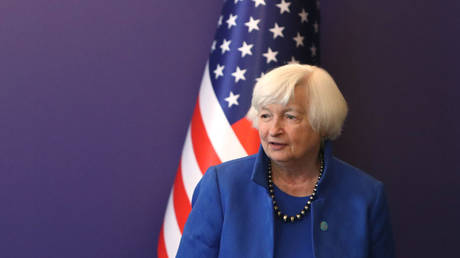
US Treasury Secretary Janet Yellen has called for President Joe Biden’s administration to consider creating a central bank cryptocurrency and to start laying the technical groundwork for the so-called digital dollar right away.
The new digital currency, as proposed by the Treasury Department, could “help preserve US global financial leadership and support the effectiveness of sanctions,” the White House said in a statement on Friday. It could also make the US payment system more “environmentally sustainable” and “promote financial inclusion and equity,” according to the statement.
“Right now, some aspects of our current payment system are too slow or too expensive,” Yellen told reporters. She added that advance work on a US central bank digital currency (CBDC) should go forward now, “in case one is determined to be in the national interest.”
Unlike existing digital money, such as commercial bank deposits held by consumers and businesses, a CBDC would be a direct liability of the US Federal Reserve Bank. It would be a digital form of sovereign US currency and would be convertible on a one-for-one basis to paper dollars or reserve balances, the Treasury Department said.
However, as the administration noted, there could be “unintended consequences” of a US CBDC, including runs on the crypto dollar during “times of stress.” The White House urged the Federal Reserve to continue its research into a potential digital dollar and said the Treasury Department would lead an interagency working group to study the implications of such a tool.
The Federal Reserve has suggested that it would take years to design and launch a CBDC and that even with the existence of a public token, there would likely be room for private groups to operate dollar-pegged cryptocurrencies.
The Treasury Department proposal came in response to Biden’s executive order last March calling on federal agencies to submit recommendations for ensuring responsible development of digital assets. Based on the agencies’ reports, the administration may increase regulation of digital assets, such as imposing “common sense efficiency standards” on cryptocurrency mining, and crack down on “unfair, deceptive or abusive practices.”
Expressing ‘anti-authority’ beliefs in messages on Facebook can trigger an FBI investigation, DOJ sources told the New York Post
Facebook has been reporting users to the FBI’s domestic terrorism unit for nothing more than anti-authority sentiment, the New York Post reported on Wednesday, citing Justice Department (DOJ) sources.
“Facebook provides the FBI with private conversations which are protected by the First Amendment without any subpoena,” the sources claimed, explaining this is done “outside the legal process and without probable cause.”
Merely expressing concern about the legitimacy of the 2020 US election results was enough to get users flagged, they said.
Excerpts from those messages, often highlighting the “most egregious-sounding comments out of context,” were offered to nearby FBI field offices as “leads.”
Upon receiving them, the local offices could request subpoenas from their partner US attorney’s office in order to legally obtain the private messages they had already been shown by Facebook outside the legal process, the Post’s sources claimed.
None of the subsequent FBI investigations turned up any criminal or violent activity, the sources said.
“It was a waste of our time,” one source complained, describing a “frenzy” of subpoena requests and other activity over the last 19 months aimed at backing up the claims made by the administration of President Joe Biden about the threat posed by domestic terrorism in the aftermath of the January 6 Capitol riot.
The users targeted by Facebook for this kind of surveillance were all “gun-toting, red-blooded Americans who were angry after the election and shooting off their mouths and talking about staging protests,” the source said, adding there was “nothing criminal, nothing about violence or massacring or assassinating anyone.”
Facebook initially called the DOJ sources’ claims “false” before releasing a second statement to the Post an hour later characterizing them as “wrong,” insisting the company's relationship with the FBI was “designed to protect people from harm” rather than to “proactively supply” law enforcement with the names of users expressing anti-government sentiment.
“We carefully scrutinize all government requests for user information to make sure they’re legally valid and narrowly tailored and we often push back,” Erica Sackin, a spokesperson for parent company Meta, said in the statement.
The FBI admitted it receives information “with investigative value” from social media providers and that it “maintains an ongoing dialogue to enable a quick exchange of threat information,” but would neither confirm nor deny the specific allegations made by the DOJ whistleblowers.
The agency does not believe that President Xi is set on military action, however
CIA Deputy Director David Cohen said that Chinese President Xi Jinping wants his military to be capable of seizing Taiwan by 2027, according to a CNN correspondent. However, Cohen is reported to have said that the agency still believes China wants a peaceful reunification with the island.
Cohen’s statement was reported by CNN journalist Katie Bo Lillis, who herself said that Xi is not preparing for a certain invasion of Taiwan, but rather wants “the capability to take control of Taiwan by force.”
“He has not made the decision to do that, but he has asked his military to put him in a position where if that's what he wanted to do, he would be able to,” Lillis quoted Cohen as saying. “It's still the assessment of the [Intelligence Community] as a whole that Xi's interest in Taiwan is to get control through nonmilitary means.”
Beijing has publicly stated that it intends to reunify Taiwan with the Chinese mainland by peaceful means. In a white paper published in August, the Chinese government affirmed this commitment to non-military means, but reserved “the option of taking all necessary measures.”
Taiwan rejected the “one country, two systems” approach set out in the white paper, with Taipei stating that only the people of Taiwan would decide their future.
Taiwan has governed itself since nationalist forces led by Chiang Kai-shek fled to the island in 1949, after they lost the civil war to the Communists. The US government has officially recognized, but not endorsed, China’s sovereignty over Taiwan since the 1970s.
Tensions in the Taiwan Strait reached a boiling point last month, following a visit to Taipei by US House Speaker Nancy Pelosi. With Pelosi a member of US President Joe Biden’s political party and second in the presidential line of succession, China considered the visit a tacit endorsement of Taiwanese independence, and responded by launching large-scale military exercises around Taiwan. US warships answered these drills by sailing through the strait, while Taiwan held military drills of its own.
At the time of writing, Beijing has not commented on the latest claims.
Officials reported three dead and over a dozen injured after shelling by Kiev’s forces
At least three people were killed in Friday’s strike on the civilian administration building in the city of Kherson, officials said. They added that the Ukrainian attack also left 13 people injured, most of whom were ordinary passers-by.
The Kherson Health Ministry reported that three of the wounded civilians are currently in critical condition. One of the people killed in the attack was the driver for a local official, authorities claim.
The deputy head of the Kherson administration, Kirill Stremousov, suggested on his Telegram channel that the target of the Ukrainian strike was the acting head of the Kherson military-civilian administration, Sergey Eliseev, as well as local municipal authorities of the region who were holding a meeting in the building at the time of the attack.
Local officials claim there were only civil servants and no military personnel in the building at the time of the shelling, which was allegedly carried out with five US-made HIMARS rockets.
The deputy head of the administration, Ekaterina Gubareva, has called the incident “a vile terrorist attack in broad daylight,” and urged residents to stay at home citing threats of further attacks.
The city of Kherson has been under Russian control since early March, shortly after the country launched its military operation in Ukraine. Late last month, Kiev began a counteroffensive in the region, which, according to Moscow, failed completely and left the Ukrainian military with heavy casualties.
The situation is aggravated by Kiev’s refusal to negotiate, the Russian president told India’s PM
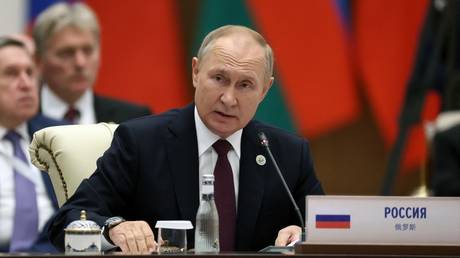
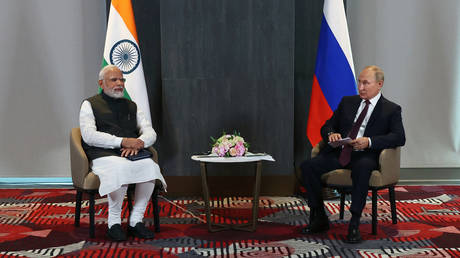
Russia is prepared to do everything possible to end the conflict in Ukraine “as soon as possible,” but Kiev refuses to talk, Russian President Vladimir Putin told Indian Prime Minister Narendra Modi on Friday. The first in-person meeting of the two leaders since 2019 took place on the sidelines of the Shanghai Cooperation Organization (SCO) summit in Samarkand, Uzbekistan.
Putin told the prime minister that he is aware of his “concerns” over the conflict in Ukraine and pledged to “do everything to ensure that all of this stops as soon as possible.”
“Unfortunately, the opposite side, the leadership of Ukraine, has refused the negotiation process. {They} declared that they want to achieve their goals by military means, or, as they say, ‘on the battlefield,’” Putin explained.
The Indian prime minister, who has been sticking to neutrality about the military conflict in Ukraine, reiterated his calls for peace during the meeting with Putin. Citing the challenges facing the world now, including food security issues and the energy crisis, Modi said that “today’s era is not an era of war.” He also said that he views his meeting with Putin as a chance to discuss progress on “the path of peace.”
“India and Russia have stayed together with each other for several decades,” he said. The US and its partners, meanwhile, have been calling on New Delhi and on Beijing to take a tougher stance on Russia amid its offensive in Ukraine.
Kiev and Moscow haven’t returned to the negotiating table since talks in Istanbul in late March fell through. Ukraine’s Western partners, meanwhile, continue supplying it with arms. Moscow, however, insists that it has not given up on the idea of peace talks with Kiev. Earlier this week, Russian Foreign Minister Sergey Lavrov made it clear that the longer the process is delayed the harder it would be to come to an agreement.
In July, Lavrov’s Ukrainian counterpart, Dmitry Kuleba, said that Kiev would only be eager to resume talks after Moscow suffers “defeat on the battlefield.” According to Kuleba, Ukrainian President Vladimir Zelensky is not ruling out “the possibility of negotiations,” but believes “there is no reason” for it at the moment. Kiev’s stance has largely remained the same ever since.
Ecuador will not be prevented from featuring at Qatar 2022 as things stand
Chile's national football team have lost their appeal to replace fellow South American rivals Ecuador at the upcoming FIFA World Cup in Qatar, though the case is now likely to head to the Court of Arbitration for Sport (CAS).
Chile had argued that Ecuador's Byron Castillo is actually Colombian and was therefore ineligible to play in eight of their World Cup qualifying games, yet FIFA deemed in a ruling on Friday that "on the basis of the documents presented, the player was to be considered as holding permanent Ecuadorian nationality in accordance" and therefore threw the complaint out.
Chile claimed to have evidence that proves Castillo is Colombian, but will now have to take their campaign to the CAS in Lausanne, Switzerland which might order an urgent hearing given the World Cup starts in around nine weeks.
Chile started preparing their case after the World Cup draw on April 1 placed Ecuador in Group A with hosts Qatar – against whom they will play the competition's opening game – as well as the Netherlands and Senegal.
If Ecuador are forced to forfeit the eight matches that Castillo starred in, Chile would rise to fourth in the South American qualifying group and pinch the last automatic qualifying spot.
Should Chile prove successful in their plight, many Ecuador fans will be left out of pocket after thousands of them bought tickets and paid for accommodation to see their country's fourth World Cup appearance.
Chile's appeal was heard remotely on Thursday with three judges present via video link from FIFA's headquarters in Zurich.
The chief judge was former White House Counsel from the Barack Obama administration Neil Eggleston, who continued a trend of FIFA rarely overturning a ruling handed down by its disciplinary committee.
The complaint is Chile's second in back-to-back World Cup qualifying campaigns.
In 2018, on the road to Russia, Bolivia had to forfeit two games after fielding an ineligible player. Along with Peru, Chile claimed that late substitute Nelson Cabrera was Paraguay-born and had also been capped by its national team.
Bolivia lost a CAS appeal, but Chile still didn't qualify for Russia after Peru were awarded three extra points and rose above them in the South American qualifying group.
FIFA created stricter rules for Qatar 2022 in response to the furor, requiring all players in qualifying matches to produce "valid permanent international passports" for match officials to check.
But as things stand, 2015 and 2016 Copa America kings Chile look certain to miss out on featuring at FIFA's showpiece international tournament for the second time running.
A Chicago Bulls jersey worn by the basketball icon has fetched over $10 million
Michael Jordan can boast another world record after the sale of his old Chicago Bulls jersey made history this week.
Sotheby's auction house has revealed that a jersey worn by the 59-year-old in Game 1 of the 1998 NBA Finals, as featured on the well-received documentary 'The Last Dance', had been sold for $10.1 million.
It is said that the popularity of the documentary has also re-triggered an interest in Jordan and the Bulls that has now stretched to memorabilia.
And though the Bulls lost the game in question 88-85 to the Utah Jazz, the jersey from the series which the Bulls won 4-2 – helping Jordan and the franchise complete their second 'three-peat' of NBA championships – eclipsed the $9.28 million recently paid for Diego Maradona's 'Hand of God' jersey worn at the 1986 World Cup in a memorable win over England in the quarter-finals.
A record-breaking day. Michael Jordan's iconic 1998 NBA Finals 'The Last Dance' jersey has sold for $10.1 million, setting records for a basketball jersey, any game-worn sports memorabilia, and most valuable #MichaelJordan item ever sold at auction. pic.twitter.com/7t8G98N5pW
While the jersey has broken the previous record for game-worn items in sports, this stretches to memorabilia related to Jordan overall with the previous record held by an autographed 1997-98 Upper Deck Game Jersey patch card that sold for $2.7 million in October last year.
A fortnight later, on October 25, Jordan's Nike Air Ships from his rookie season were also sold for $1.47 million.
As for the most expensive piece of sporting memorabilia, bragging rights in this aspect go to New York Yankees slugger Micky Mantle's 1952 Topps card sold for $12.6 million late last month.
The migrants lasted less than two days on the affluent island of Martha’s Vineyard
Massachusetts Governor Charlie Baker activated the National Guard to deal with 50 illegal immigrants flown into the “sanctuary” of Martha’s Vineyard by Florida Governor Ron DeSantis. The migrants were removed from the island and sent to a military base.
DeSantis sent two planeloads of migrants to Martha’s Vineyard on Wednesday, in a bid to draw attention to President Joe Biden’s apparent failure to secure the US’ border with Mexico, and to protest his administration’s practice of shipping large groups of migrants from the border to towns and cities across the US, often without the permission of state authorities.
The new arrivals lasted less than two days on the affluent island. After declaring the situation a “humanitarian crisis,” Governor Baker called up 125 members of the Massachusetts National Guard on Friday and loaded the immigrants onto buses, bound for Joint Base Cape Cod.
HAPPENING NOW: Migrants, flown into Martha’s Vineyard by Fl’s governor, are boarding buses. They’ll be heading to Joint Base Cape Cod, according to officials. 125 Mass National Guard members are being activated to assist. @NBCNewspic.twitter.com/RLwxNPu8GM
Baker said that the migrants, who mostly hail from Venezuela, will be given “temporary shelter and humanitarian services” at the base.
Martha’s Vineyard is a popular summer retreat for America’s elite. Sitting in the Atlantic just south of Cape Cod, it is around 90% white, and its residents overwhelmingly voted for Biden in 2020. The median home value on Martha’s Vineyard is just under $800,000, and former President Barack Obama owns a $12 million mansion on the island.
While Martha’s Vineyard did not declare itself a ‘sanctuary’ jurisdiction – as some US cities and municipalities did during the Trump administration to signify that they would not enforce federal immigration laws – Massachusetts is a de-facto sanctuary state, and signs dotted around the island proclaim that authorities there “stand with immigrants [and] refugees.”
Once the two planeloads of immigrants arrived, however, Baker declared that “the island communities are not equipped to provide sustainable accommodation,” and locals told reporters that “they have to move somewhere else.”
Republicans countered that 50 migrants represent just a fraction of the tens of thousands who enter border communities every month. “We are not a sanctuary state,” DeSantis declared on Thursday, adding that Florida would “gladly facilitate the transport of illegal immigrants to sanctuary jurisdictions.”
"Republicans are playing politics with human beings,” Biden said on Thursday, claiming that there is “a process in place to manage migrants at the border.”